Apollo 8 is the clearest predecessor to Artemis II, but the comparison matters only if it is used carefully
Any serious explanation of Artemis II eventually runs into Apollo, and especially Apollo 8. That 1968 mission was the first time human beings left Earth orbit, traveled to the Moon, and returned safely home. Artemis II is not a reenactment of that flight, but it occupies a similar position inside its own program: a crewed lunar proving mission whose deeper purpose is to make later missions more credible. For readers searching for the Artemis II Apollo 8 comparison, this is the historical lens that explains it best. The legacy matters because it helps explain why a mission without a landing can still become one of the decisive flights of an era.
Why Apollo still frames how people see Artemis
Apollo remains the unavoidable reference point for any American crewed mission that heads toward the Moon. Its achievements were technically extraordinary, but they were also culturally overwhelming. The language of lunar exploration, the famous imagery, and the public memory of what it meant to go to the Moon were all shaped by Apollo so strongly that later missions still enter a story Apollo largely wrote.
That is especially true for Artemis II, because it asks the public to care about a mission that will not land on the Moon. Apollo already taught audiences how to interpret that kind of flight. Apollo 8 mattered not because it ended the lunar program’s story, but because it made the rest of the story feel real. Artemis II sits in a comparable place. Its task is to prove that a modern crew, spacecraft, launch system, and mission architecture can function together beyond Earth orbit with enough confidence to support the missions that follow.
The comparison is helpful up to a point. It gives people a way to understand why Artemis II is consequential even without a landing. But Apollo should be treated as a framework for interpretation, not as a script that Artemis must repeat. The older program offers precedent, not a set of assumptions that modern exploration is required to inherit unchanged.
Apollo 8 imagery shaped how later generations imagined lunar flight, including how they now read Artemis II. Source:Wikimedia Commons
Why Apollo 8 is the strongest historical comparison
Of all the Apollo missions, Apollo 8 is the clearest analogue for Artemis II. Both missions send human beings toward the Moon before any landing attempt in their respective programs. Both carry the burden of proving that crews can operate safely and effectively at lunar distance. Both function as threshold missions: flights that matter because they transform a larger exploration plan from theory into demonstrated possibility.
The differences are just as important as the similarities. Apollo 8 entered lunar orbit, while Artemis II is designed around a free-return flyby. Apollo flew under intense geopolitical pressure and in a program moving at extraordinary speed. Artemis is being developed in a slower, more collaborative environment shaped by international partnerships, long program timelines, and the ambition to sustain repeated missions rather than rush to a single symbolic victory. Those differences change the meaning of success, even if the structural role of the mission still feels familiar.
That is why Apollo 8 belongs at the center of this legacy page. It provides the sharpest historical lens for understanding Artemis II, but it also highlights the ways the new program is trying to build something broader than a simple replay of the 1960s.
What Apollo 8 achieved in 1968
Apollo 8 milestones
First crewed mission to leave Earth orbit
First humans to travel to the Moon
First crewed mission to orbit the Moon
First direct human viewing of the lunar far side
Christmas Eve 1968 broadcast watched around the world
Earthrise photograph became one of the defining images of the space age
Apollo 8 compressed an extraordinary number of firsts into a single mission. It demonstrated translunar navigation, crew operations in deep space, lunar-orbit insertion, communications management at lunar distance, and safe return from the Moon. In program terms, it was one of the most consequential test flights ever attempted. It asked astronauts and systems to perform in an environment no human crew had entered before, and it succeeded under the eyes of the world.
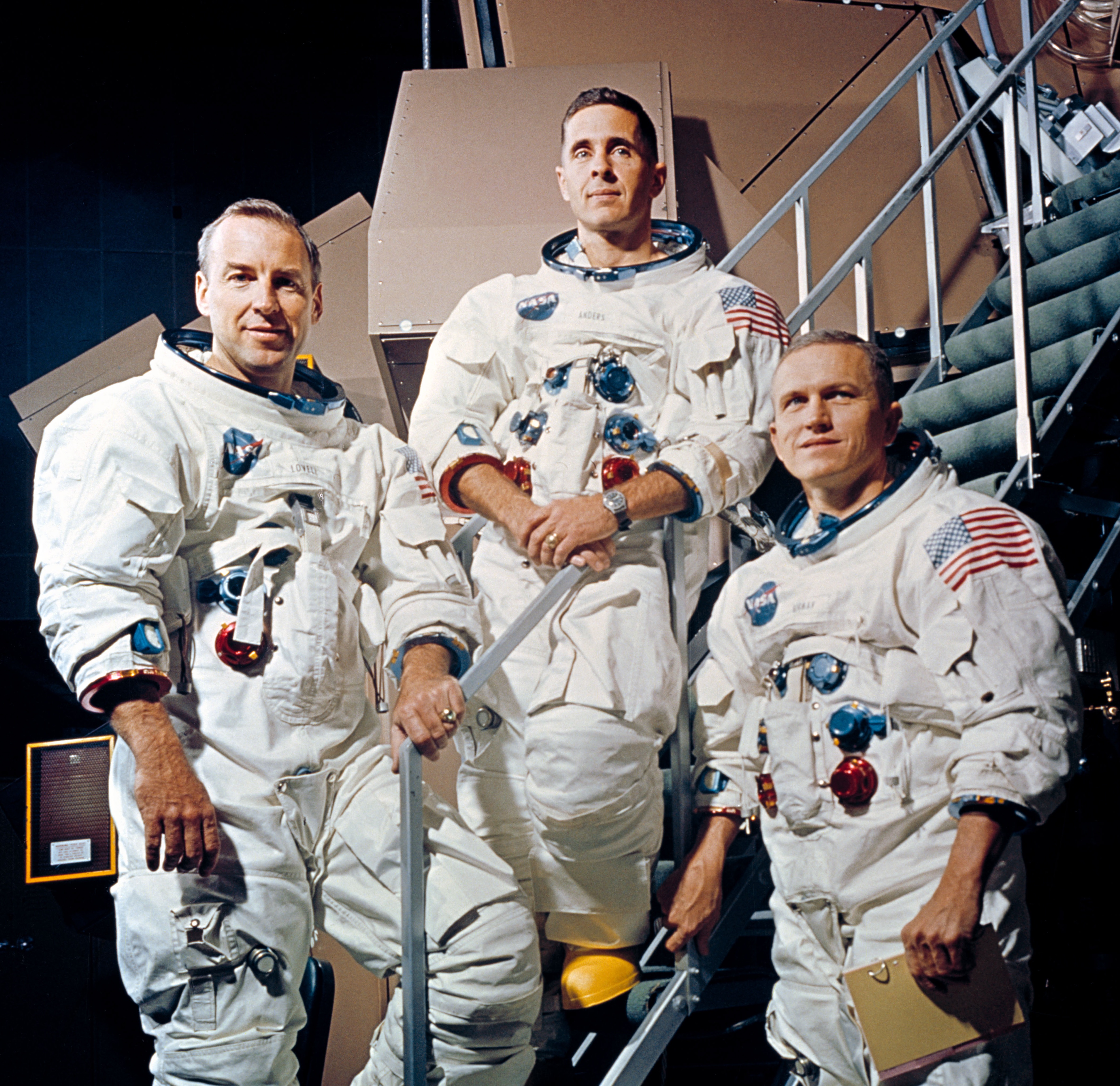
The Apollo 8 crew — Frank Borman, Jim Lovell, and William Anders — helped define the human face of the mission’s legacy. Source:Wikimedia Commons
The mission also changed the emotional and cultural meaning of spaceflight. The Earthrise photograph and the crew’s Christmas Eve broadcast gave Apollo 8 a reach that extended well beyond aerospace audiences. It was not only a technical success. It became a moment in which people saw Earth differently, as a small and shared world viewed from lunar distance. That cultural afterlife is part of why Apollo 8 still feels larger than a checklist of engineering accomplishments.
For Artemis II, this matters because Apollo 8 shows how a proving mission can have two legacies at once. It can validate systems and simultaneously reshape public imagination. Artemis II will be judged on engineering performance first, but missions of this kind also become symbols. Apollo 8 is the earlier example that makes that dual role easier to understand.
What Artemis inherits from Apollo — and what it leaves behind
Apollo 8 proved a crew could leave Earth orbit and operate at lunar distance
Before Apollo 8, no human beings had traveled beyond Earth orbit. Its success showed that a crewed spacecraft could survive translunar flight, navigate to the Moon, function in lunar orbit, and return safely through high-energy reentry. That matters for Artemis II because it established the first real template for what a non-landing lunar mission can accomplish. The mission did not put boots on the surface, yet it fundamentally changed what later missions were allowed to assume.
A proving mission can become the turning point of an entire program
Apollo 8 was not a side note before Apollo 11. It was the flight that turned a lunar landing from ambition into something that looked operationally plausible. Artemis II is built in a similar role. Its success would not be measured by a landing, but by whether it gives NASA and its partners verified confidence in the systems, procedures, and human performance needed for what comes next.
Historical parallels help, but they can also distort
The easiest story to tell is that Artemis is simply Apollo again with better hardware. That story is tidy, but wrong. Apollo was shaped by Cold War urgency, compressed timelines, and a national race framework. Artemis is slower, more international, and more explicitly aimed at sustained operations. The Apollo comparison is useful only if it clarifies Artemis II’s role without pretending the modern mission lives inside the same political logic.
Artemis inherits much of Apollo’s operational vocabulary. Terms like translunar injection, lunar flyby, far side, reentry, and splashdown still make sense because Apollo established the original grammar of crewed lunar flight. The public also inherits Apollo’s expectations. Many people instinctively measure any lunar mission against the drama, speed, and historical clarity of the 1960s program.
But Artemis departs from Apollo in important ways. Orion uses modern avionics and digital interfaces. The service module is provided by the European Space Agency. The Artemis II crew includes a Canadian astronaut, making the mission visibly international at the crew level. The broader program is not presented as a one-shot race, but as the beginning of a campaign meant to support repeated missions, longer surface activity, and eventually experience that could matter for even deeper exploration. Artemis looks backward because lunar missions always will, but it is trying to justify a future Apollo itself never had to construct.
Why the Apollo legacy matters for Artemis II now
When Artemis II flies, people will inevitably ask whether it feels as bold as Apollo and whether it measures up to that earlier standard. Those questions are understandable, but they only help if they are framed with care. Apollo was extraordinary, but it belonged to a different political moment and a different program logic. Artemis should not be judged only by whether it recreates Apollo’s drama.
A better question is whether Artemis II can do for its own era what Apollo 8 did for the late 1960s: prove that the road ahead is operationally real. If Artemis II demonstrates that Orion, SLS, mission control, recovery teams, and international partners can function together on a crewed lunar mission, then it will have fulfilled a role strikingly similar to Apollo 8’s even in a very different historical setting.
That is the real value of the legacy. Apollo matters here not because it makes Artemis feel familiar, but because it explains why a mission devoted to testing can still become one of the decisive flights in a larger exploration story.